Tuesday, February 9, 2016

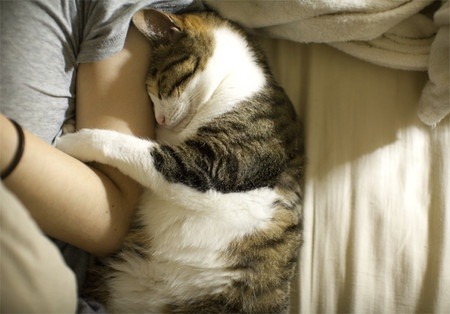
A Cuddly Cat

Some cats are natural-born cuddlers, while others will make you work for their affections through treats and attention. Others will remain standoffish no matter how much attention you lavish on them. For best results, start training them young and don’t push a kitty who prefers a hands-off approach.

Build Trust
Bond with your cat by establishing trust. Feed her, provide her with a clean litter box and offer her toys and enriching, interactive activities. Don’t chase her or grab her for forced cuddling if she’s resistant. Instead, take your time and work up to a more physical relationship.

Use Positive Reinforcement
Get your cat to associate you with positive things. For example, talk to her while you feed her, and while she’s eating a special treat, stroke her gently so she associates your touch with good food. Similarly, sit on the couch with treats in your pocket and when she comes over to you on her own, offer a goodie. Your cat will soon figure out that when she’s in close proximity to you, good things happen.

Play Often
If your cat is a bit standoffish, interact with her through play. Use a cat toy wand feather dancer or a cat toys teaser wand toy to grab and keep her attention. When she seems worn out, slow the rate of play and put the toy beside you, or in your lap. When she comes to you, give her a treat to make the interaction a pleasant and rewarding activity.

Start Early, Go Slow
Kittens who are handled from a young age are more likely to be social and physically interactive than those who are not. If you adopt an older kitty or a rescue cat, it may take time and patience to establish trust and for your new pet to let her guard down. Don’t push your cat to cuddle. Some cats may need to work up to physical contact.

Accept Loners
While some cats will land in your lap from the first day you bring them home, others are destined to be loners forever. Older, re-homed cats, abused animals or semi-feral cats may always resist being touched or held. Try to consider this part of their personality and be content to love them from afar.

Thursday, February 4, 2016

Build your Cat a Jungle Gym

Cats have an ancestral need to climb and jump. Indoor cats especially can benefit from the exercise opportunity a cat jungle gym affords. Pet retailers offer cat jungle gyms that can be assembled easily, but these can be behemoth and can put a real dent in the cat paraphernalia budget. With a little ingenuity, some wood, a few tools and an assortment of my little lion cat treats and cat-approved the super da bird toys, you can build your own cat jungle gym.

Map out your cat jungle gym on the wall of your choice, using your stud finder to determine where you'll be placing your shelf brackets. You'll need to screw your brackets into studs so the shelves of your jungle gym will support your cat's weight. Mark the stud locations with your pencil. You are the master of this design, so consider attaching some shelves at an angle to allow your cats to climb, and leave a distance between others, to encourage your kitty to jump.

Using your measuring tape, measure the distance between your studs. This will guide you on how long your shelves will be. You'll want the length of your shelves to overhang your brackets by a couple of inches on each end of the shelf.

Measure your shelves on your 1-by-6-by-8, using the measurements you took in step 2. If you want a large number of shelves, you may need a second untreated board.

Cut your board or boards using the circular saw. Sand your shelves to remove any rough edges.

Using the wood glue, attach your brackets to your shelves, making sure they're placed properly to mount them according to your design and the location of your studs. Allow the glue to dry thoroughly.

Secure your brackets further by attaching them to the shelves using the wood screws and power screwdriver. Place a screw every couple of inches for maximum stability.

Measure the shelves. Using the utility knife cut the carpet scraps according to the measurements you took in step 9. Staple the carpet pieces to your shelves. Make sure the staples go all the way into the carpet's pile to avoid injury to your cats. If the carpet is very low pile, consider using a carpet adhesive.

Mount your shelves according to your design, angling some shelves, and attaching more than one at a single stud point at varying heights.

Hang cat da bird grasshopper toys from your shelves using the twine. Staple the twine to the underside of your shelf, making sure your staples are flush with the underside of your shelf.

Monday, February 1, 2016

Is Tug of War with Toys Safe?

If Pebbles pounces on your shoelaces every time you walk by her, she clearly wants to play. Engaging in a gentle game of tug-of-war helps her get out some of her pent-up energy and keeps you completely entertained. While tug-of-war is probably an OK game to play with the cat, it can be dangerous if the game gets out of hand or if you use the wrong types of long cat wand toys.


How to Play
Pick up a piece of yarn, Pebbles’ favorite wand or a long feather cat wand toy. Just avoid anything that stretches -- after all, you don’t want to let go and have the toy smack her between the eyes. Wiggle the toy in front of the cat until she takes a nibble and gentle tug at it. If she’s in the mood for tug-of-war, she’ll chomp down on the toy and pull back, trying to get it away from you. After several seconds, slowly let go. Likely, she'll drop the toy. Do it over again. Intrigue her by playing several short games of tug-of-war with a variety of toys rather than pulling at the same toy for an extended period of time.

When to Stop
Pebbles shouldn’t be growling, hissing, nipping or swatting at your hand during your game of tug-of-war. These signs of aggression let you know she is over-stimulated. She needs a few moments to cool down. Stop immediately and let her relax for a few minutes. When she settles down, pick up the toy and go back to playing. If she continues to exhibit aggressive behavior, tug-of-war may not be an ideal game to play with her.

Dangers
If Pebbles starts playing too rough, stop your tug-of-war session immediately. Felines have fragile teeth; if yours tugs at her cat toy wand elastic toy too hard, she could break or even pull out a tooth. Watch for blood, drooling or pawing at her face after your play session. These are signs something in her mouth is awry. In addition, if you’re playing with a string, put it away in a safe spot once you’re done playing. String can be a choking hazard if Pebbles decides to chomp on it on her own.

Other Games
As soon as Pebbles starts getting bored with tug-of-war -- or if it makes her act a little mean -- play fetch with her instead, just like you would with Fido. Toss Pebbles’ mouse toy across the room, giving her the opportunity to pounce on it and then encourage her to bring it back to you. Not all cats understand the game of fetch or care to play. Cats love to hunt, though, so you may pique your cat's interest by wiggling her feathery wand toy on the floor right next to the sofa. When she makes her move, quickly shake it in a new spot. Her natural hunting instincts will kick in, making her want to catch this prey.

Wednesday, January 27, 2016

Teething Kittens

Despite their small size, teething kittens can damage your furniture, clothes and shoes with their chewing. Your kitten may even decide your fingers and toes are fair game. Provide your kitten with appropriate toys and items to chew to help prevent damage to yourself and your home and protect your cat from chewing and swallowing things that may harm her.

Your kitten will begin teething at approximately 3 1/2 to 4 months of age. Teething continues until all of her adult teeth have grown in at approximately 6 or 7 months of age.

During this process, your kitten's adult teeth begin developing in the gums and placing pressure on the baby teeth. Eventually, the roots of the baby teeth disappear and the adult teeth push the kitten teeth out. Usually, your kitten swallows the baby teeth, but you may occasionally see a baby tooth on the floor or in her dish.

Signs that your kitten is teething include:
  1. Chewing
  2. Breath odor
  3. Drooling
  4. Irritability
  5. Being reluctant to eat

Chew Toys For Your Kitten

There are many chew da bird toys to consider for your teething kitten. When selecting a toy, make sure it is not something she can swallow or choke on. Avoid hard toys as these may damage her teeth.

Some original da bird toys are designed to be chilled in the refrigerator or freezer to provide relief for your kitten's sore gums. As an alternative, you can freeze a wet wash cloth and give it to your kitten.

Your kitten also may enjoy chewing on grass in a pot. Select a grass that is safe for cats, such as barley, oats, rye, wheat or a combination. You can purchase grass or seeds to grow your own at many pet supply stores.

Although cat teaser wand toys, such as strings or feathers, are not suitable for your kitten to chew on, using them to get your kitten moving can help distract her from teething and drain excess energy. This reduces the chances of her chewing on inappropriate items in your home.

Friday, January 22, 2016

Making a Litter Box Attractive for Cats

Up to 10 percent of all cats develop elimination problems during their lives, according to the American Society for the Prevention of Cruelty to Animals. Cats stop using their litter boxes for a variety of reasons, including a medical condition, anxiety or territorial aggression in multiple-cat homes. When your cat stops using its litter box and eliminates in other parts of your home, it stresses out you and your cat. Prevent this messy behavior and train your cat to use its litter box properly by making it pleasant and safe to use.

Place the litter box in a quiet area of your home that your cat can easily get to at all times. Avoid noisy areas such as a laundry rooms, or inaccessible, dark places such as closets or basements. Put the box in a location where the cat can easily escape and does not feel cornered. If possible, place the box in a spot your cat has been eliminating in inappropriately.

Give your cat a litter box without a lid that has enough room for it to turn around comfortably. For young kittens or older cats, provide a litter box with low sides so your cat can easily step in and out of the box.

Use unscented, clumping cat litter that you can scoop and fill the box only 2 to 3 inches deep. Your cat will not use a dirty litter box, so clean it at least once a day with a litter scoop. There are several options for clumping litter, including clay-, wheat- and corn-based formulas. Determine your cat's preference by placing litter boxes side-by-side and fill them with each type. Continue to provide the type of litter in the box your cat uses the most.

You  can also place da bird feather toys around the litter box. Choose her favorite cat clothes toys so that she'll know where the litter box is too. You can also but the litter box around the area where she usually plays these da bird kitty puff toys. This way, she can often see the litter box and learn where it is.

Place Cat Attract Litter in the litter box if your cat still refuses to use the litter box with unscented, clumping litter. This specialty litter contains ingredients designed to attract your cat to use its litter box. You can also sprinkle Cat Attract Litter Additive in your cat's regular litter to make the box more appealing to your cat.

Provide an ample number of litter boxes if you have more than one cat or more than one story to your home. You need to provide enough litter boxes for each of your cats plus one extra, according to the ASPCA. Place at least one box on each level of your home so your cat always has easy access to a litter box.

Clean previous sites of inappropriate elimination by your cat with an enzymatic cleaner to remove all traces of the urine or feces odor. This will prevent your cat from returning to these locations instead of its litter box to eliminate.

Wednesday, January 20, 2016

Getting Rid of Cat Spray Smell

Cats spray to mark their territory with pheromones as a way of communicating with other cats. The smell is so unmistakable, pet owners are rarely unaware of this particularly malodorous form of feline expression. Often, neutering or spaying or playing with cat wands, the cat will stop unwanted spraying. You can do this with a da bird kopter or cat clothing accessories. However, the problem of removing the smell remains. Homemade options range from the use of vinegar and baking soda to commercial products containing enzymes. Removing all traces of the cat spray smell is crucial in discouraging your cat from marking again.

A Natural Recipe
Soak up as much urine as possible with paper towels or an old towel. If the urine is on carpet or rugs, try not to rub it into the fibers.

Mix one part vinegar with one part water in a container. Pour this mixture onto the soiled area until saturated. Allow to dry.

Combine one cup of 3 percent hydrogen peroxide with 1 teaspoon of a mild liquid soap in a small spray bottle.

Sprinkle baking soda over the spot then spray with the hydrogen peroxide mixture. Test this mix on a small area of the carpet or fabric to be sure it will not stain the fibers.

Use a small scrub brush to gently work the mixture into the fibers of the carpet or rug then let dry. Vacuum the mixture and repeat if necessary.

Other Methods
Saturate the area with a commercial product such as Nature's Miracle or Odor Neutralizer. Follow the manufacturer's instructions for application on various surfaces. Rather than mask the smell as deodorizers do, these products contain enzymes that will break down the molecules that cause cat spray smell. These products are available at many pet stores and department stores.

For soiled clothes, towels or other washables, pour 1/2 cup of vinegar, either white or apple cider, into the wash along with the detergent and launder as usual. Vinegar is a powerful odor neutralizer.

Spray outside bushes or sidewalks with a half and half mixture of vinegar and water until the area is free of cat spray urine.

Hire a professional. Most professional cleaners use the hot-water extraction method. This is a very effective form of steam cleaning used for deep cleaning of carpets and rugs.

Tuesday, January 12, 2016

Tapeworn Treatment in Cats

Almost all cats, at some point in their lives, are afflicted by internal parasites. One such parasite, the tapeworm, can be particularly troublesome, and should be treated as soon as possible. It is also possible to take some steps to prevent tapeworm infection. This article is designed to inform readers about how to prevent tapeworm infection, as well as how to cure a tapeworm infection in a cat.

Call your veterinarian if you notice the symptoms of a tapeworm infestation. A tapeworm infestation is most frequently discovered when segments of the tapeworm are found in and on a cat's stool and in the hair around the cat's anal region. Tapeworm segments often look similar to large grains of rice or small segments of a pasta noodle. They are easily visible to the naked eye.

Collect a sample of the stool and bring it to your veterinarian, who can often identify tapeworm segments on sight, but may also choose to do a fecal examination to confirm infestation. Wait for the right time to collect the sample. Play with your cat using da bird pack or cat wire wand with it before the grooming session. This da bird refill will help calm down the cat and less aggressive. It is likely that your veterinarian will require this, particularly if this is your cat's first infestation.

Cure the infestation by administering the medication that your veterinarian prescribes. Your veterinarian will likely prescribe a tapeworm dewormer, such as Droncit or Drontal, to eradicate the parasites. This medication usually consists of one dose immediately, and a second dose approximately two weeks later. After administering the medication, you may see the dead worms pass in the cat's stool. This is perfectly normal and nothing to become alarmed about.

Start your cat on some type of flea preventative to prevent further infestation, such as Frontline, Advantage or Revolution, and try to keep your pet from hunting and ingesting small animals, which can also cause infestation.

Consider obtaining a prescription from your veterinarian for the treatment medication, especially if your pet has repeated infestations. You will then be able to purchase the medication from online retailers, such as PetMeds, at a much lower cost and without having to pay for a veterinary visit.